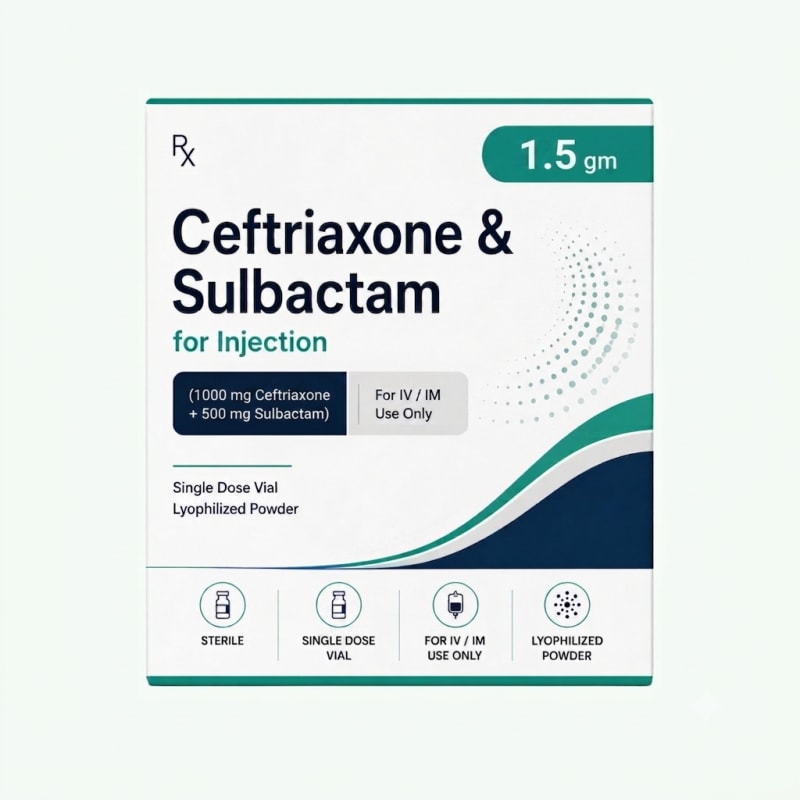
Ceftriaxone & Sulbactam for Injection 1.5gm
Pack Sizes Available
Product Description
Technical Specifications
- Drug Class: Third-generation cephalosporin with beta-lactamase inhibitor combination
- Composition: Ceftriaxone Sodium equivalent to 1000mg Ceftriaxone + Sulbactam Sodium equivalent to 500mg Sulbactam per vial
- Dosage Form: Sterile powder for reconstitution
- Route of Administration: Intravenous (IV), or intramuscular (IM) where appropriate
- Storage Conditions: Store below 25°C in a dry place, protected from light
- Shelf Life: 24 months from date of manufacture, subject to storage conditions
This combination is used for severe bacterial infections including complicated respiratory and intra-abdominal infections, septicemia, and other serious presentations where beta-lactamase producing resistant organisms are a clinical concern requiring both ceftriaxone and a beta-lactamase inhibitor.
It is typically given by intravenous injection or infusion, reconstituted with the diluent specified in the product insert, with dosing determined by the treating physician based on the severity of the infection and the patient's kidney function.
In infections where beta-lactamase producing resistant bacteria are suspected, plain ceftriaxone may be ineffective. The added sulbactam protects ceftriaxone from enzymatic breakdown, restoring its activity against these resistant organisms in more serious clinical scenarios.
Patients with known hypersensitivity to cephalosporins or penicillins should not receive this combination. Dose adjustment may be needed in patients with significant kidney impairment, and it should never be co-administered with calcium-containing solutions.
Institutional and government tender buyers receive a certificate of analysis for each batch, along with drug master file documentation and stability data, and support for the specific registration paperwork required by the importing country's regulatory authority.
The unreconstituted powder should be stored below 25°C in a dry environment away from direct light, and it does not require cold chain shipping. Vials are packed during export to guard against heat and moisture exposure, with shelf life confirmed at shipment.
Related Products
Explore more high-quality items from our Anti-Infectives & Antibiotics range.

Aztreonam for Injection USP 1gm
Bacterial infections don't wait for perfect conditions, and neither should a hospital's antibiotic stock. Aztreonam occupies a specific and useful place in that stock: a monobactam, structurally distinct from penicillins and cephalosporins, built to target gram-negative aerobic organisms with minimal cross-reactivity concerns for patients with beta-lactam allergies. That distinction matters more to procurement teams than it might first appear, because it means this molecule fills a gap other antibiotics in a formulary simply cannot. Each vial of this 1gm formulation contains sterile Aztreonam USP, buffered with L-Arginine, supplied as a lyophilized powder ready for reconstitution with Sterile Water for Injection. The powder dissolves cleanly, reconstitutes without excessive foaming, and yields a solution suited for both intramuscular and intravenous administration depending on clinical protocol. Hospitals value predictability in a product like this, and predictability is exactly what a well-controlled lyophilization process delivers, batch after batch. We manufacture and export this product under WHO-GMP compliant conditions, with full documentation available for buyers who need it: COA, COPP, Free Sale Certificate, stability data, and regulatory dossiers formatted for the destination market's requirements. Fifteen years in the export business has taught us that paperwork delays cost more than the product itself, so we keep documentation ready before a buyer even asks. Packaging is built around what actually moves through customs and hospital pharmacies without friction. Single vials, ten-vial export cartons, cold-chain-appropriate secondary packaging where required, and labeling that can be customized to a country's language and regulatory format. Private labeling is available for distributors who want their own brand on the box, a request we handle often enough that it barely counts as a special case anymore. Pricing works on volume, and we structure it that way deliberately. A first-time importer testing the market with a modest order gets a fair quote. A returning distributor placing a container-load order gets a better one. MOQs flex based on what a buyer's market actually needs, not on some rigid internal policy that ignores the reality of different countries having very different demand curves. Somebody in West Africa and somebody in Eastern Europe are not buying antibiotics the same way, and we don't pretend they are. Communication stays direct. One point of contact, no ticket queues, no three-week wait for a simple stock update. If a shipment date shifts, you hear about it before you have to ask. If a regulatory document needs a signature or a stamp, we chase it down rather than leaving the buyer to track it themselves. Lead times are quoted honestly, which sounds like a low bar until you've dealt with suppliers who quote optimistically and deliver whenever. Cold chain logistics, when required, are handled through partners experienced specifically in pharmaceutical shipping, not general freight forwarders learning temperature control on the job. For importers building a critical care or hospital antibiotic line, this is a product worth having a reliable source for, and reliability is the entire pitch here.

Cloxacillin Injection 1.0gm
Severe staphylococcal infections don't leave much room for undertreatment, which is exactly why the 1 gram vial exists alongside the 250mg and 500mg strengths in our cloxacillin range. When a physician is managing endocarditis, deep-seated osteomyelitis, or septicemia caused by beta-lactamase producing staphylococci, the higher single-vial dose reduces the number of reconstitutions and injections a critically ill patient needs to go through in a day. Cloxacillin Injection 1.0gm is supplied as a sterile powder containing cloxacillin sodium equivalent to 1 gram of cloxacillin, manufactured under GMP conditions and intended for intramuscular or, more commonly at this strength, intravenous administration. Being a penicillinase-resistant penicillin, it remains active against strains that would otherwise render ordinary penicillin useless, which is the entire reason this drug class still holds a place in hospital antibiotic formularies decades after its introduction. Buyers sourcing the 1gm strength are usually hospital pharmacies, tertiary care distributors, or government procurement programs managing ICU-level antibiotic stock, and their concerns tend to run a little different from a retail pharmacy chain. Consistency across batches matters enormously when a hospital's protocol depends on predictable dosing, and documentation needs to be airtight for tender submissions. We've supported exactly this kind of buyer for fifteen years, and our regulatory team is used to preparing the drug master files, CoAs, and stability data that these processes require. Pricing at this strength is naturally higher per vial than the 250mg or 500mg versions, but we structure our export pricing to stay competitive on a per-milligram basis, since that's really what a buyer comparing suppliers is calculating anyway. Minimum order quantities flex with the size of your operation. A first-time distributor testing our product against a competitor's gets the same attentive handling as a returning government buyer placing a large tender order. Logistics for this product are relatively simple since it doesn't require cold chain shipping, just protection from heat, moisture, and direct light during transit. We package accordingly, and every shipment travels with a certificate of analysis. Third-party inspection can be arranged for markets where that's part of the import process, and our team handles the paperwork side of registration support for countries across Africa, the CIS region, Southeast Asia, and Latin America where we already have an established export history. Given that this strength is often ordered for hospital or institutional use, we're happy to walk through batch traceability, cold storage alternatives if your climate demands it, or private labeling options if you're building your own branded line. Reach out directly with your requirements and expect a real, specific answer rather than a generic brochure reply.

Cloxacillin Injection 500mg
Ask any hospital pharmacist which antibiotic vial they reorder most often for staph coverage and Cloxacillin 500mg tends to come up fast. It sits at the strength most adults actually get prescribed, which makes it the workhorse version of the three we manufacture. The 250mg and 1gm vials matter too, but 500mg is the one that keeps formularies stocked week after week. This is cloxacillin sodium, a penicillinase-resistant penicillin, supplied as a sterile powder for reconstitution ahead of intramuscular or intravenous use. It targets infections caused by beta-lactamase producing staphylococci, the strains that render ordinary penicillin useless. Clinicians reach for it in skin and soft tissue infections, respiratory infections, and, at physician discretion, more serious conditions like bone or bloodstream infections where staphylococcal resistance is a known concern. We manufacture it under GMP-compliant conditions at our partner facilities, and every batch is tested for potency and sterility before it leaves for packaging. None of that matters much to a buyer, though, until it shows up as a certificate of analysis attached to your shipment, which is exactly how we handle it. If your import authority wants third-party verification on top of that, we arrange it without turning it into a negotiation. Sourcing pharmaceutical injectables from an unfamiliar country can feel risky the first time, especially for buyers who have been burned before by suppliers who overpromised on lead times or underdelivered on documentation. We've spent fifteen years building relationships with distributors, wholesalers, and hospital procurement teams across Africa, the Middle East, Southeast Asia, and Latin America precisely because those relationships depend on doing the boring parts right: correct labeling, correct paperwork, and shipments that arrive when we said they would. Minimum order quantities are flexible rather than fixed at some arbitrary threshold that only suits large-scale buyers. A smaller distributor testing the market gets treated the same as a returning client with a standing order. Pricing reflects volume, obviously, but it's never inflated for the sake of it. Storage before use is uncomplicated. Keep the sealed vials cool, dry, and out of direct sunlight, and the powder holds its potency comfortably through the labeled shelf life. Once reconstituted, though, timing matters, and hospital staff should follow the product insert closely regarding usable duration after mixing. Whether you're placing a first trial order or restocking a running contract, reach out with your specific requirements, whether that's batch documentation, freight terms, or private labeling for your own market. You'll get a direct answer from someone who actually knows this product, not a form response.