
Pantoprazole for Injection 40mg
Pack Sizes Available
Product Description
Technical Specifications
- Active Ingredient: Pantoprazole Sodium equivalent to 40mg Pantoprazole
- Dosage Form: Powder for solution for injection or infusion
- Drug Class: Proton pump inhibitor
- Administration Route: Intravenous injection (over 2 minutes) or infusion (over 15 minutes)
- Drug Interaction Profile: Lower interaction potential compared to some other PPIs
- Vial Type: Clear glass vial with rubber stopper and flip-off seal
- Storage Condition: Store below 25 degrees C, protect from light
- Shelf Life: 24 to 36 months from date of manufacture
Pantoprazole Injection is used for gastroesophageal reflux disease, erosive esophagitis, and general acid suppression in patients unable to take oral medication, and it is also used as part of acute GI bleeding management protocols in some hospital settings.
Pantoprazole has a comparatively lower potential for interactions with other drugs metabolised through the liver's cytochrome P450 pathway, which makes it a common choice for patients on complex medication regimens, including those on antiplatelet drugs like clopidogrel.
The powder is reconstituted with the manufacturer-specified diluent, typically sterile water for injection, and further diluted if being given as an infusion, following the exact volumes and sequence indicated on the product insert.
It is generally administered as a slow intravenous injection over about 2 minutes or as an infusion over 15 minutes, depending on the clinical protocol, but should not be given as a rapid bolus without following the specified administration rate.
Yes, it is commonly used for stress ulcer prophylaxis in critically ill patients, particularly those on mechanical ventilation or with other risk factors for GI bleeding, as part of standard ICU care protocols.
Unopened vials should be stored below 25 degrees Celsius, protected from light, in their original packaging. Reconstituted and diluted solutions should be used within the timeframe specified on the product insert.

Caspofungin Acetate for Injection
Fungal infections rarely wait for the perfect moment. They show up in ICUs, in oncology wards, in patients whose immune systems are already fighting three other battles, and clinicians need an antifungal that works fast without adding a fourth problem to the list. Caspofungin Acetate belongs to the echinocandin class, and unlike the older azole and polyene antifungals, it goes after the fungal cell wall rather than the cell membrane, which gives it a cleaner safety profile in patients who are already on a stack of other medications. Each vial is supplied as a lyophilized powder that gets reconstituted before intravenous infusion. Dosing typically follows a single 70mg loading dose on day one, then 50mg daily thereafter, which is exactly why exporters who understand hospital procurement stock both strengths together rather than forcing a buyer to source them separately. It treats invasive candidiasis, candidemia, esophageal candidiasis, and invasive aspergillosis in patients who haven't responded to or can't tolerate other therapies, making it a mainstay in tertiary care antifungal protocols across markets that import from India. What tends to matter most for an importer stocking this molecule is consistency between batches. Echinocandins are notoriously fussy to manufacture at scale, and a supplier who can't hold potency and reconstitution behavior steady from lot to lot creates real clinical risk downstream. We work with WHO-GMP compliant manufacturing partners who maintain tight cold-chain discipline from lyophilization through final packing, because a vial that arrives even slightly out of spec is a vial a hospital pharmacy will reject on sight. Regulatory paperwork for critical care antifungals gets scrutinized more than most, so every batch ships with a complete dossier: certificate of analysis, stability data, GMP certification, and where required, a free sale certificate that clears customs without the back-and-forth that stalls shipments for weeks. That documentation discipline, paired with flexible minimum order quantities that don't force smaller distributors into warehousing more stock than they can move, is what keeps repeat buyers coming back rather than shopping around every quarter. Fifteen years of exporting critical care injectables from India has taught us that price matters, but reliability of supply matters more when a hospital's antifungal stewardship program depends on a molecule actually being on the shelf when it's needed. Communication stays direct and personal rather than routed through layers of account managers, so questions about batch availability, lead times, or documentation get answered by someone who actually knows the shipment, not a call center script. For distributors serving hospital pharmacies, oncology centers, and critical care units, Caspofungin Acetate represents one of those products where the margin on any single vial is modest but the relationship built around dependable supply pays off across every reorder cycle that follows.

Colistimethate Sodium for Injection 1 MIU
There is a certain irony in colistin's comeback story. A drug developed in the 1950s, largely shelved for decades because of its reputation for kidney toxicity, is now one of the last reliable options standing against multidrug-resistant gram-negative bacteria that shrug off almost everything newer. Hospitals reach for Colistimethate Sodium when Klebsiella, Pseudomonas, or Acinetobacter infections have outmanoeuvred the usual carbapenem lineup, which places this product firmly in the last-line antibiotic category rather than a routine one. Colistimethate is the inactive prodrug form of colistin, converted to its active state in the body after administration, and the 1 MIU vial represents the smaller of the commonly stocked strengths, useful for weight-based dosing in patients where a full higher-strength vial would overshoot the calculated requirement. It's supplied as a lyophilized powder reconstituted before intravenous infusion, and correct reconstitution matters more here than with most antibiotics given the narrow therapeutic window between an effective dose and one that stresses the kidneys. For an exporter, colistin is not a casual product line. Regulatory bodies worldwide have tightened oversight on it precisely because of its toxicity profile and its status as a treatment of last resort, which means importers expect airtight documentation before they will even quote a price to their own institutional buyers. Every batch we supply travels with full analytical certification, stability data, and manufacturing traceability, because a tender for a critical care antibiotic will get rejected outright if the paperwork has gaps. Cold chain handling from the point of lyophilization to the point of delivery is non-negotiable, and we treat it that way rather than as a checkbox. Distributors serving ICUs and infectious disease units don't have room for a shipment that arrives compromised, not when the patients receiving it are often already critically ill with limited remaining treatment options. One pattern we've noticed working with importers over 15 years is that colistin orders tend to come in waves tied to local resistance patterns and hospital tender cycles rather than steady month-to-month demand, so we keep flexible MOQs and don't force distributors to warehouse more than their actual pipeline calls for. Communication stays direct between our team and the buyer, without layers of intermediaries slowing down quotes or documentation requests. For wholesalers and hospital suppliers building out a critical care antibiotic portfolio, Colistimethate Sodium 1 MIU fills a specific and important gap, and getting it from a partner who understands both the pharmacology and the paperwork saves headaches that a lower price alone never will.
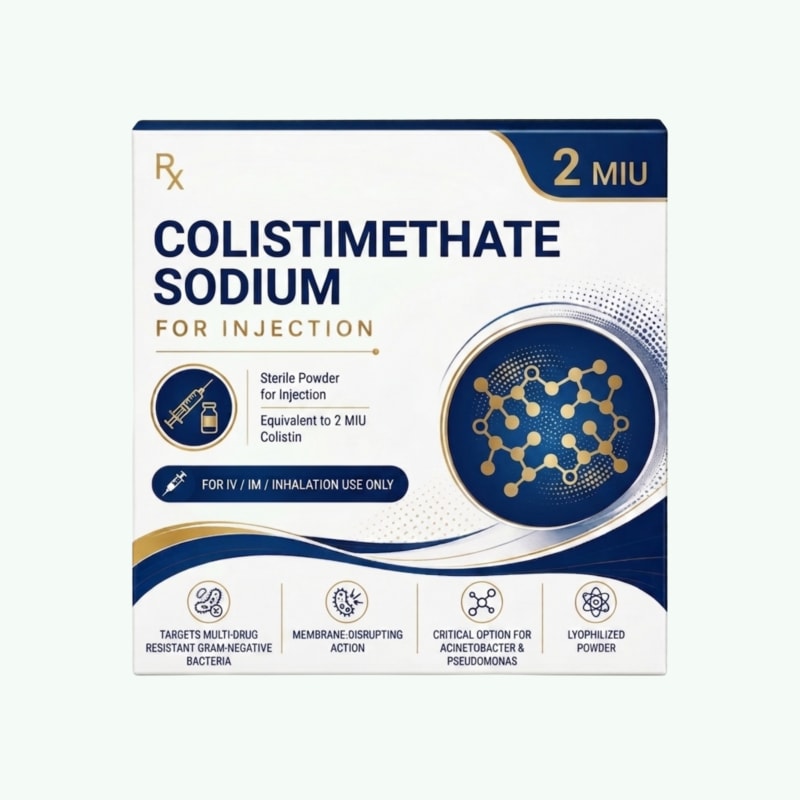
Colistimethate Sodium for Injection 2 MIU
Ask any ICU pharmacist which antibiotics they hope they never have to reach for, and colistin usually makes the list, not because it doesn't work but because reaching for it means the infection has already outsmarted the safer first-line options. Colistimethate Sodium in the 2 MIU strength is the middle ground most institutional pharmacies keep in stock, sized to cover a typical adult dose without requiring a nurse to reconstitute and combine multiple smaller vials at 3am. The drug itself is a polymyxin antibiotic, active against the gram-negative organisms that cause the most stubborn hospital-acquired infections: ventilator-associated pneumonia, bloodstream infections in ICU patients, and complicated UTIs where Pseudomonas or carbapenem-resistant Enterobacteriaceae have already defeated the usual regimen. It's not a first date kind of drug. It's the one you call when everything else has been tried. Because colistin's therapeutic window sits close to its toxic threshold, the strength stocked matters as much as the drug itself. A 2 MIU vial lets clinical staff dose more precisely without wasting product or splitting vials mid-shift, which sounds like a small operational detail until you're the pharmacy tech doing it for the fourth time in a night. We supply this strength specifically because importers have told us, repeatedly, that it's the one their hospital customers actually reorder most. Manufacturing colistin at consistent potency requires tight process control, and we source exclusively from partners holding WHO-GMP certification with documented cold-chain handling from lyophilization onward. Every shipment carries a full certificate of analysis, stability data package, and the regulatory documentation that customs and hospital procurement teams require before a critical care antibiotic clears their system, because incomplete paperwork on a last-resort antibiotic gets flagged faster than on almost any other product category. Demand for this molecule tends to spike unpredictably, tied to local resistance surveillance data rather than a steady calendar, so we keep order quantities flexible rather than forcing distributors into bulk commitments that don't match their actual tender cycles. Fifteen years in the export business has made one thing clear: the relationships that last are the ones where a distributor can call, ask a direct question about batch documentation or lead time, and get a straight answer from someone who actually knows the shipment. For wholesalers and hospital suppliers who need a dependable source of last-line gram-negative coverage, Colistimethate Sodium 2 MIU rounds out a critical care antibiotic portfolio in the strength that clinical teams reach for most often.