
Caspofungin Acetate for Injection
Fungal infections rarely wait for the perfect moment. They show up in ICUs, in oncology wards, in patients whose immune systems are already fighting three other battles, and clinicians need an antifungal that works fast without adding a fourth problem to the list. Caspofungin Acetate belongs to the echinocandin class, and unlike the older azole and polyene antifungals, it goes after the fungal cell wall rather than the cell membrane, which gives it a cleaner safety profile in patients who are already on a stack of other medications. Each vial is supplied as a lyophilized powder that gets reconstituted before intravenous infusion. Dosing typically follows a single 70mg loading dose on day one, then 50mg daily thereafter, which is exactly why exporters who understand hospital procurement stock both strengths together rather than forcing a buyer to source them separately. It treats invasive candidiasis, candidemia, esophageal candidiasis, and invasive aspergillosis in patients who haven't responded to or can't tolerate other therapies, making it a mainstay in tertiary care antifungal protocols across markets that import from India. What tends to matter most for an importer stocking this molecule is consistency between batches. Echinocandins are notoriously fussy to manufacture at scale, and a supplier who can't hold potency and reconstitution behavior steady from lot to lot creates real clinical risk downstream. We work with WHO-GMP compliant manufacturing partners who maintain tight cold-chain discipline from lyophilization through final packing, because a vial that arrives even slightly out of spec is a vial a hospital pharmacy will reject on sight. Regulatory paperwork for critical care antifungals gets scrutinized more than most, so every batch ships with a complete dossier: certificate of analysis, stability data, GMP certification, and where required, a free sale certificate that clears customs without the back-and-forth that stalls shipments for weeks. That documentation discipline, paired with flexible minimum order quantities that don't force smaller distributors into warehousing more stock than they can move, is what keeps repeat buyers coming back rather than shopping around every quarter. Fifteen years of exporting critical care injectables from India has taught us that price matters, but reliability of supply matters more when a hospital's antifungal stewardship program depends on a molecule actually being on the shelf when it's needed. Communication stays direct and personal rather than routed through layers of account managers, so questions about batch availability, lead times, or documentation get answered by someone who actually knows the shipment, not a call center script. For distributors serving hospital pharmacies, oncology centers, and critical care units, Caspofungin Acetate represents one of those products where the margin on any single vial is modest but the relationship built around dependable supply pays off across every reorder cycle that follows.

Colistimethate Sodium for Injection 1 MIU
There is a certain irony in colistin's comeback story. A drug developed in the 1950s, largely shelved for decades because of its reputation for kidney toxicity, is now one of the last reliable options standing against multidrug-resistant gram-negative bacteria that shrug off almost everything newer. Hospitals reach for Colistimethate Sodium when Klebsiella, Pseudomonas, or Acinetobacter infections have outmanoeuvred the usual carbapenem lineup, which places this product firmly in the last-line antibiotic category rather than a routine one. Colistimethate is the inactive prodrug form of colistin, converted to its active state in the body after administration, and the 1 MIU vial represents the smaller of the commonly stocked strengths, useful for weight-based dosing in patients where a full higher-strength vial would overshoot the calculated requirement. It's supplied as a lyophilized powder reconstituted before intravenous infusion, and correct reconstitution matters more here than with most antibiotics given the narrow therapeutic window between an effective dose and one that stresses the kidneys. For an exporter, colistin is not a casual product line. Regulatory bodies worldwide have tightened oversight on it precisely because of its toxicity profile and its status as a treatment of last resort, which means importers expect airtight documentation before they will even quote a price to their own institutional buyers. Every batch we supply travels with full analytical certification, stability data, and manufacturing traceability, because a tender for a critical care antibiotic will get rejected outright if the paperwork has gaps. Cold chain handling from the point of lyophilization to the point of delivery is non-negotiable, and we treat it that way rather than as a checkbox. Distributors serving ICUs and infectious disease units don't have room for a shipment that arrives compromised, not when the patients receiving it are often already critically ill with limited remaining treatment options. One pattern we've noticed working with importers over 15 years is that colistin orders tend to come in waves tied to local resistance patterns and hospital tender cycles rather than steady month-to-month demand, so we keep flexible MOQs and don't force distributors to warehouse more than their actual pipeline calls for. Communication stays direct between our team and the buyer, without layers of intermediaries slowing down quotes or documentation requests. For wholesalers and hospital suppliers building out a critical care antibiotic portfolio, Colistimethate Sodium 1 MIU fills a specific and important gap, and getting it from a partner who understands both the pharmacology and the paperwork saves headaches that a lower price alone never will.
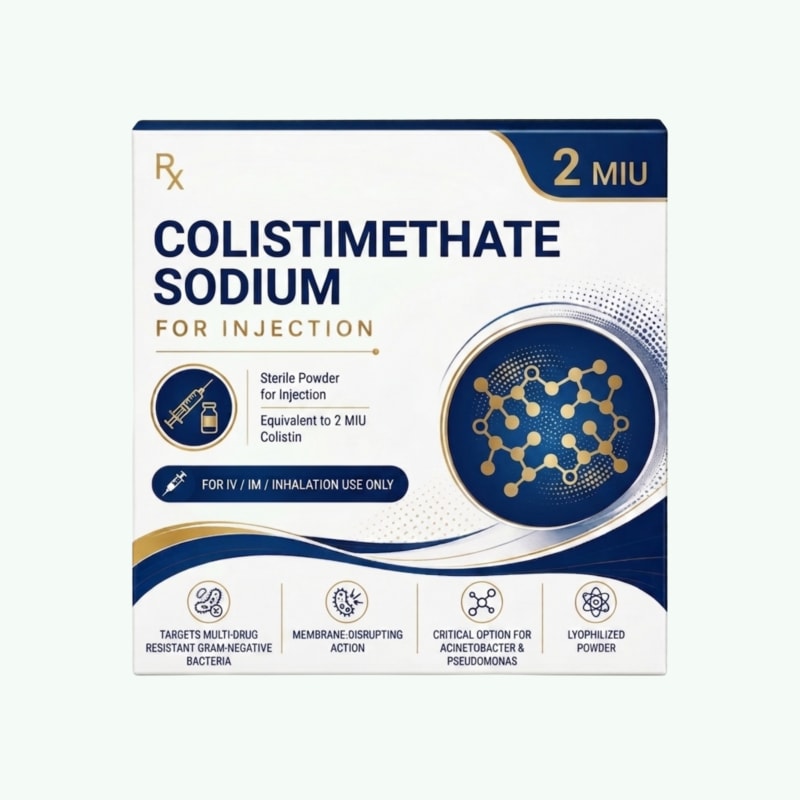
Colistimethate Sodium for Injection 2 MIU
Ask any ICU pharmacist which antibiotics they hope they never have to reach for, and colistin usually makes the list, not because it doesn't work but because reaching for it means the infection has already outsmarted the safer first-line options. Colistimethate Sodium in the 2 MIU strength is the middle ground most institutional pharmacies keep in stock, sized to cover a typical adult dose without requiring a nurse to reconstitute and combine multiple smaller vials at 3am. The drug itself is a polymyxin antibiotic, active against the gram-negative organisms that cause the most stubborn hospital-acquired infections: ventilator-associated pneumonia, bloodstream infections in ICU patients, and complicated UTIs where Pseudomonas or carbapenem-resistant Enterobacteriaceae have already defeated the usual regimen. It's not a first date kind of drug. It's the one you call when everything else has been tried. Because colistin's therapeutic window sits close to its toxic threshold, the strength stocked matters as much as the drug itself. A 2 MIU vial lets clinical staff dose more precisely without wasting product or splitting vials mid-shift, which sounds like a small operational detail until you're the pharmacy tech doing it for the fourth time in a night. We supply this strength specifically because importers have told us, repeatedly, that it's the one their hospital customers actually reorder most. Manufacturing colistin at consistent potency requires tight process control, and we source exclusively from partners holding WHO-GMP certification with documented cold-chain handling from lyophilization onward. Every shipment carries a full certificate of analysis, stability data package, and the regulatory documentation that customs and hospital procurement teams require before a critical care antibiotic clears their system, because incomplete paperwork on a last-resort antibiotic gets flagged faster than on almost any other product category. Demand for this molecule tends to spike unpredictably, tied to local resistance surveillance data rather than a steady calendar, so we keep order quantities flexible rather than forcing distributors into bulk commitments that don't match their actual tender cycles. Fifteen years in the export business has made one thing clear: the relationships that last are the ones where a distributor can call, ask a direct question about batch documentation or lead time, and get a straight answer from someone who actually knows the shipment. For wholesalers and hospital suppliers who need a dependable source of last-line gram-negative coverage, Colistimethate Sodium 2 MIU rounds out a critical care antibiotic portfolio in the strength that clinical teams reach for most often.

Clarithromycin for Injection 500mg
A patient who can't swallow a tablet still needs their pneumonia treated, and that's the entire reason Clarithromycin exists in injectable form. Oral clarithromycin has been a workhorse macrolide antibiotic for decades, but hospitalised patients on ventilators, those in post-surgical recovery, or anyone with a compromised gut can't rely on a pill making it past the stomach lining, which is where the IV formulation earns its place on the hospital formulary. Each 500mg vial contains clarithromycin lactobionate, reconstituted first with sterile water and then diluted further before administration as a slow IV infusion, never as a bolus injection and never intramuscularly. It's indicated for community-acquired pneumonia, bacterial bronchitis, and skin or soft tissue infections where oral therapy isn't practical, and it retains the broad gram-positive and gram-negative coverage that makes macrolides useful across a wide range of respiratory infections. The reconstitution chemistry on this molecule is genuinely finicky. It requires the correct diluent in the correct sequence, or the solution precipitates, and a batch that doesn't dissolve cleanly is a batch a hospital pharmacist sends straight back. We work with manufacturers who've refined their lyophilization and fill process specifically to avoid this problem, which sounds like a minor technical point until you're the distributor explaining to a hospital why half a shipment came back. For importers stocking hospital antibiotic ranges, having a supplier who can move quickly on documentation matters just as much as the product itself. Every batch we export ships with certificate of analysis, GMP compliance certification, and stability data covering the full claimed shelf life, so customs clearance and hospital pharmacy intake don't stall waiting on missing paperwork. Flexible order quantities mean a smaller regional distributor can stock a reasonable volume without committing to a container load they can't move before expiry. What distinguishes Clarithromycin for Injection from some of the flashier newer antibiotics is that demand for it is steady rather than spiky, tied to routine respiratory infection season rather than resistance outbreaks, which makes it a dependable, predictable line item for a distributor building a recurring order pattern. After 15 years exporting hospital-grade injectables from India, that predictability is exactly the kind of product relationship that keeps a partnership going year after year, backed by clear communication and delivery timelines a buyer can actually plan around. For hospital suppliers and pharmaceutical wholesalers rounding out a respiratory antibiotic portfolio, this 500mg vial fills the gap between oral therapy and the heavier IV antibiotics reserved for resistant infections.

Clarithromycin for Injection 250mg
Not every patient needing IV clarithromycin needs the full 500mg dose. Paediatric cases, smaller adults, and patients on renal-adjusted regimens (where the standard dose is halved for those with significant kidney impairment) often call for exactly this 250mg strength, which is why we stock it as a companion to the more commonly ordered 500mg vial rather than expecting every buyer to split a larger vial and estimate the remainder. Clarithromycin remains one of the more dependable macrolide antibiotics for respiratory tract infections, bacterial bronchitis, and certain skin infections, valued for its tissue penetration and its activity against organisms that cause community-acquired pneumonia. In its injectable form, it serves patients who cannot reliably take oral medication, whether that's due to intubation, post-operative status, or severe illness that makes swallowing a tablet impractical. Getting the smaller strength manufactured to the same quality standard as the larger one isn't automatic. Lower-fill vials still need the identical lyophilization process, and cutting corners on a smaller batch is exactly the kind of shortcut that shows up as inconsistent reconstitution or reduced potency months later. We source this strength from the same WHO-GMP certified manufacturing lines producing the 500mg vial, so buyers aren't choosing between quality and dose flexibility. Hospital pharmacies serving paediatric wards or renal units are often smaller-volume buyers by nature, and we've structured minimum order quantities to reflect that reality rather than forcing a distributor supplying a children's hospital to commit to the same volumes as one supplying a general adult ICU. Every shipment still carries the full documentation package: certificate of analysis, GMP certification, and stability data, because a smaller order doesn't mean a lighter compliance file. Working with importers across different regulatory environments for the better part of 15 years has taught us that the products with lower order volumes are often the ones where a distributor most values quick, direct answers, since a paediatric hospital pharmacist has neither the time nor the patience for a slow-moving supply chain when a child's treatment is on the line. Clear communication and realistic delivery timelines matter more here, not less, than on the bulk-order lines. For wholesalers supplying speciality units, paediatric hospitals, or renal care centres, this 250mg strength closes a gap that larger exporters often overlook in favour of chasing bigger single-strength volumes.

Esomeprazole for Injection 40mg
A patient bleeding from a peptic ulcer doesn't have time for a tablet to dissolve and take effect. That's the entire clinical case for IV proton pump inhibitors, and Esomeprazole 40mg has become one of the most reached-for options in exactly that situation, whether it's acute GI bleeding, a patient who can't take anything by mouth after surgery, or someone on a ventilator who still needs acid suppression to prevent stress ulcers. As the S-isomer of omeprazole, esomeprazole offers slightly more predictable pharmacokinetics than its parent compound, which matters in critical care where dosing consistency across a diverse patient population counts for something. The 40mg vial arrives as a white to off-white powder, reconstituted before IV bolus or infusion administration, and it's compatible with sterile water for injection and 0.9% sodium chloride, though other diluents should be avoided since compatibility hasn't been established across the board. GI bleeding protocols often call for an 80mg loading dose followed by a continuous 8mg per hour infusion over the following three days, meaning a single hospital admission can burn through a meaningful number of vials fast. That volume makes reliable, consistent supply more important than a marginally lower price per vial, because a stockout mid-protocol is not a minor inconvenience for a gastroenterology unit managing an active bleed. Manufacturing esomeprazole injection to a consistent standard requires tight control over the lyophilization process, since the compound is sensitive to both light and moisture, and a batch with even slight degradation can affect potency in ways that matter clinically. We source from WHO-GMP certified partners who maintain proper cold-chain and light-protected handling from production through to the final export carton, and every shipment carries a complete documentation set covering certificate of analysis, stability data, and GMP compliance, because gastroenterology and critical care procurement teams check this paperwork closely before a product ever reaches their shelves. Flexible minimum order quantities mean a mid-sized hospital distributor doesn't need to commit to volumes designed for a national tender just to get competitive pricing, and that flexibility, paired with straightforward one-on-one communication rather than a maze of account layers, is what 15 years of exporting critical care injectables from India has taught us actually keeps a buyer relationship going. For hospital pharmacies, gastroenterology units, and general wholesalers building a critical care GI portfolio, Esomeprazole 40mg for Injection covers one of the most consistently ordered acid-suppression lines on the formulary.
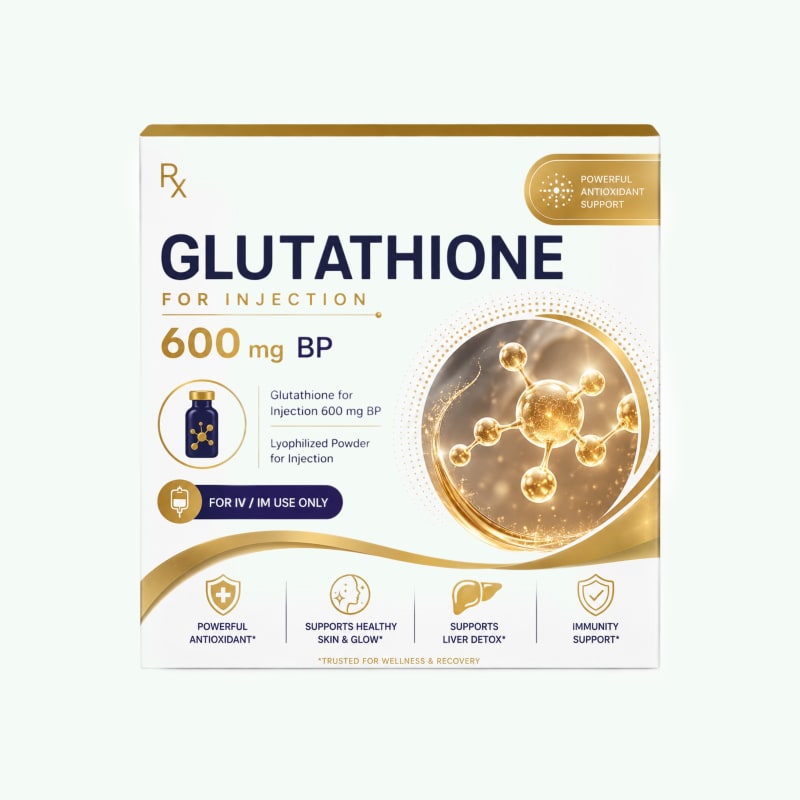
Glutathione for Injection 600mg BP
Ask a dermatology clinic in the Gulf, Southeast Asia, or West Africa what their single most requested injectable is, and there's a decent chance Glutathione comes up before half the actual medicines on the shelf. It occupies an unusual spot in a pharmaceutical catalogue, straddling clinical antioxidant therapy and the aesthetic skin-brightening market that has grown considerably across export destinations where demand for this compound runs high. Glutathione is a naturally occurring tripeptide made of cysteine, glutamic acid, and glycine, produced by the liver and present in every cell of the body as one of its primary antioxidant defences. The injectable 600mg BP-grade formulation is supplied as a lyophilized powder, reconstituted before intravenous or intramuscular administration, and clinics typically use it once or twice weekly across a course running several weeks, depending on the treatment goal, whether that's supporting liver detoxification pathways or a skin-brightening protocol. For an exporter, the 600mg strength has become the practical standard because it delivers a meaningful single dose without requiring a clinic to combine multiple smaller vials, cutting down preparation time in a busy aesthetic practice where appointment turnover matters. It sits alongside our broader dermatology and wellness injectable range, and demand for it tends to track closely with the growth of medical aesthetics clinics in a given import market rather than following the more predictable patterns of antibiotics or antifungals. BP-grade purity matters here more than buyers sometimes realise, because glutathione is chemically prone to oxidation, and a poorly manufactured or improperly stored batch degrades faster than most other lyophilized products on a formulary. We work with manufacturers who maintain tight lyophilization control and proper cold-chain handling straight through to export packing, because a batch that's lost potency in transit isn't something a clinic discovers until a patient asks why they're not seeing results. Every shipment travels with a full certificate of analysis and GMP documentation, and because glutathione demand often comes from smaller aesthetic clinics and dermatology practices rather than large hospital systems, we keep order quantities flexible enough that a distributor supplying five or six clinics doesn't need to commit to hospital-scale volumes just to access competitive export pricing. Fifteen years supplying pharmaceutical and wellness injectables from India has shown us that this particular product category rewards a supplier who understands both the clinical use case and the aesthetic market driving demand, and personalised communication with distributors, rather than a one-size-fits-all sales pitch, is what keeps this line moving steadily across reorder cycles.

Hydrocortisone Sodium Succinate for Injection 200mg
When a patient's body suddenly can't produce its own cortisol, whether from adrenal crisis, severe sepsis, or an anaphylactic reaction spiralling out of control, there's no time to wait for an oral tablet to be absorbed. Hydrocortisone Sodium Succinate exists for exactly this moment, and the 200mg strength covers the higher end of typical emergency dosing without requiring a nurse to draw from two vials during a code. This is the water-soluble sodium succinate ester of hydrocortisone, chosen specifically because it dissolves fast and allows a high dose to be delivered in a small volume of diluent, which matters when every minute counts in an acute allergic reaction or adrenal insufficiency crisis. Once reconstituted, it can be given as a direct IV push or added to an IV bag for infusion, and its effects become measurable within about an hour, a timeline that matters a great deal in critical care. Beyond emergency use, this strength shows up regularly in the management of severe asthma exacerbations, transfusion reactions, and a range of autoimmune and dermatologic conditions where a short but intense course of systemic corticosteroid is needed. Because it's one of the more frequently stocked emergency drugs across ICUs, ERs, and ambulance services, consistent availability matters more here than almost any other line in a critical care catalogue, since a stockout on hydrocortisone is a stockout on something a hospital genuinely cannot substitute quickly. Manufacturing this molecule to a consistent standard requires careful pH control during reconstitution and stable lyophilization, since the succinate ester is sensitive to degradation if handling isn't tight throughout the production chain. We source exclusively from WHO-GMP certified manufacturers who maintain that discipline, and every export batch carries full documentation, certificate of analysis, and stability data, because emergency drug procurement teams check this paperwork with particular care given how often the product ends up in a life-or-death situation. We keep minimum order quantities flexible enough that a regional distributor supplying a handful of hospitals can maintain adequate emergency stock without warehousing volumes better suited to a national tender. After 15 years exporting critical care injectables from India, we've found that the buyers who reorder this product most consistently value a supplier who answers questions about batch traceability and lead times directly, without routing every query through layers of account management. For hospital pharmacies, emergency departments, and critical care wholesalers, Hydrocortisone Sodium Succinate 200mg fills one of the genuinely irreplaceable slots on an emergency drug formulary.
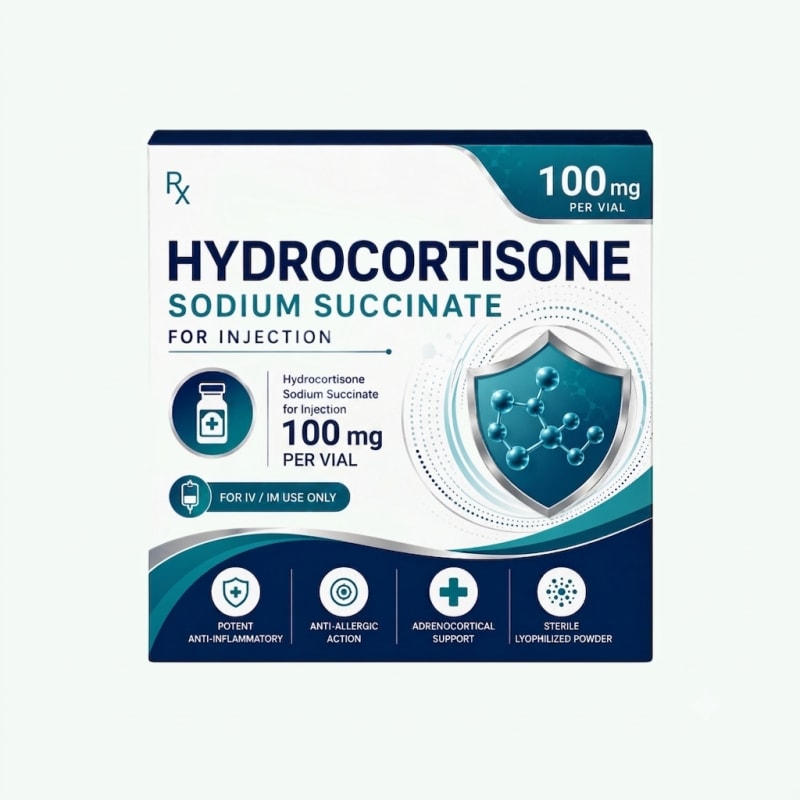
Hydrocortisone Sodium Succinate for Injection 100mg
The 100mg strength of Hydrocortisone Sodium Succinate is the one you'll find in nearly every crash cart, and for good reason. It's sized for the standard adult emergency dose in moderate allergic reactions and asthma flares, common enough that a distributor supplying general hospitals, ambulance services, and urgent care clinics will move more volume of this strength than almost any other emergency corticosteroid on the shelf. Pharmacologically identical to the 200mg version, just at half the dose per vial, it's the water-soluble sodium succinate ester of hydrocortisone, engineered specifically for rapid dissolution and quick systemic absorption after intravenous or intramuscular injection. It replicates the body's own natural glucocorticoid activity, which makes it the first-line choice in situations like adrenal insufficiency where the patient's system genuinely cannot produce enough cortisol on its own. Because 100mg sits at the more frequently prescribed end of the dosing range, covering acute asthma, moderate allergic reactions, and a range of dermatologic and rheumatologic flare-ups, it tends to be the strength that moves through inventory fastest. That turnover is exactly why consistency between batches matters so much here; a distributor reordering this product every few weeks needs each shipment to reconstitute and perform identically to the last one, without surprises at the pharmacy counter. Our manufacturing partners hold WHO-GMP certification and maintain the pH control and lyophilization discipline this molecule demands, since the succinate ester is chemically sensitive and any inconsistency in production shows up as reduced potency or poor reconstitution behaviour. Every export shipment includes the complete documentation set, certificate of analysis, GMP certification, and stability data, so a hospital pharmacy or ambulance service procurement team clears it through their intake process without delay. Given how frequently this product reorders, we've built in enough flexibility on minimum order quantities that a distributor can keep a steady rolling stock rather than either overcommitting to a large volume or running the risk of a gap in supply on a drug this critical. Fifteen years of exporting emergency and critical care injectables from India has shown that the products ordered most often are exactly the ones where a buyer values a straightforward, responsive supplier relationship over chasing the absolute lowest quote. For hospital pharmacies, emergency services, and general medical wholesalers, Hydrocortisone Sodium Succinate 100mg is the workhorse strength that keeps an emergency corticosteroid supply chain running smoothly.
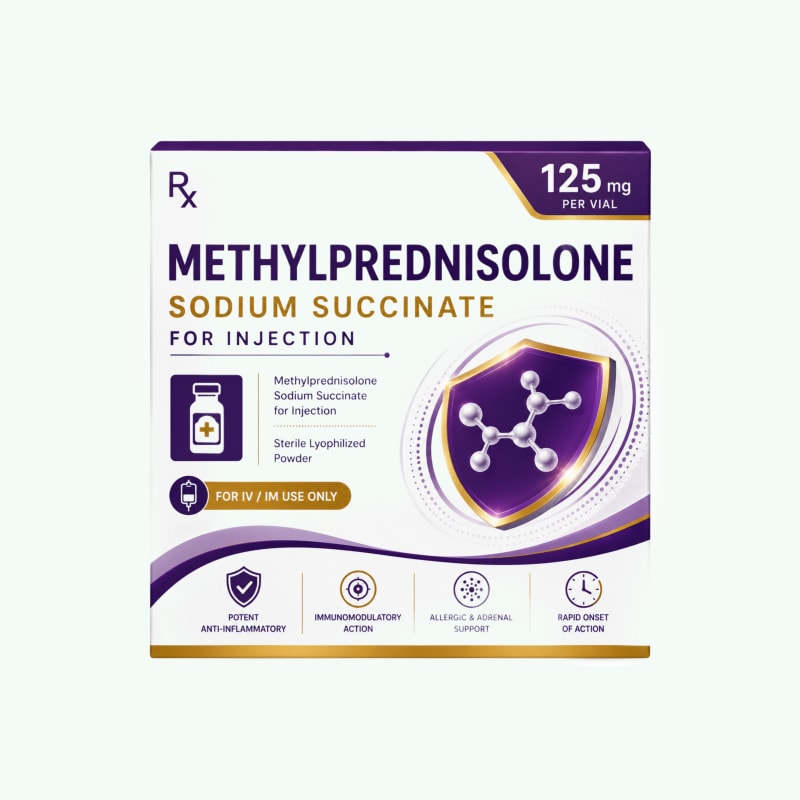
Methylprednisolone Sodium Succinate for Injection 125mg
Methylprednisolone gets called on in moments that don't allow for a slow ramp-up: an acute asthma attack that isn't responding to bronchodilators, a severe allergic reaction, a multiple sclerosis relapse that needs high-dose steroid pulse therapy fast. The 125mg strength sits comfortably in the middle of the commonly stocked doses, large enough to cover a real emergency dose but not so large that it's overkill for routine acute inflammatory flares. As the sodium succinate ester of methylprednisolone, this formulation is water-soluble and reconstitutes quickly, letting a high dose of corticosteroid reach the bloodstream in a small injection volume rather than requiring a slow oral titration that a patient in acute distress simply can't wait for. It carries roughly five times the anti-inflammatory potency of hydrocortisone milligram for milligram, which is part of why clinicians reach for it specifically when a stronger, faster corticosteroid effect is needed. The drug shows up across a genuinely wide range of hospital departments: pulmonology for severe asthma and COPD exacerbations, neurology for MS relapses, rheumatology for autoimmune flares, and transplant medicine for preventing organ rejection, which means a single hospital pharmacy may be ordering it for half a dozen different clinical teams simultaneously. That breadth of use is exactly why consistent supply and batch reliability matter more here than for a narrower speciality product. Manufacturing this molecule to specification requires careful control of the succinate ester chemistry during lyophilization, since the compound needs to reconstitute cleanly into a stable solution suitable for immediate IV or IM administration. We source from WHO-GMP certified manufacturing partners with a track record on corticosteroid injectables specifically, and every shipment ships with full documentation, certificate of analysis, GMP certification, and stability data, since hospital procurement across most export destinations treats corticosteroid paperwork with the same rigour as antibiotics. Given how broadly this product is used across hospital departments, order volumes vary considerably between a small regional clinic and a large tertiary hospital, so we've kept minimum order quantities flexible enough to serve both without forcing either into an inventory position that doesn't match their actual patient volume. After 15 years exporting hospital-grade injectables from India, the relationships that have lasted are the ones built on direct communication, realistic delivery timelines, and a supplier who actually understands where this drug fits into a hospital's day-to-day operations. For hospital pharmacies and wholesalers supplying pulmonology, neurology, and rheumatology departments, Methylprednisolone Sodium Succinate 125mg is a genuinely versatile line that earns its place across several different formularies at once.

Methylprednisolone Sodium Succinate for Injection 500mg
Some conditions don't respond to a modest steroid dose, and that's where the 500mg strength of Methylprednisolone Sodium Succinate takes over. This is the vial reached for in severe autoimmune flares, acute spinal cord injury protocols, high-dose pulse therapy for lupus nephritis, and situations where the treating team has decided that half-measures on corticosteroid dosing simply won't get the inflammation under control fast enough. As a multiple-dose formulation in many export configurations, the 500mg vial allows a pharmacy to draw the exact quantity a patient's weight-based protocol calls for, rather than being locked into fixed single-dose increments. Once reconstituted with the appropriate diluent, it delivers the same rapid-acting glucocorticoid effect as the lower strengths, just scaled up for situations where 1 to 2 grams of daily methylprednisolone might be the actual treatment target over several consecutive days. Hospitals ordering this strength tend to be tertiary or specialist centres running active rheumatology, nephrology, or neurology pulse-steroid protocols, which means order patterns here often come in defined bursts tied to specific patient courses rather than a steady weekly baseline. That makes responsive, fast-turnaround supply more valuable to this particular buyer than to one ordering a routine, predictable-volume drug, since a specialist unit starting a pulse protocol can't always forecast demand weeks in advance. Getting a 500mg lyophilized cake to reconstitute cleanly and consistently at this fill volume takes real manufacturing discipline, and we work only with WHO-GMP certified partners who have demonstrated that consistency across multiple batches rather than a single validation run. Every export shipment carries complete documentation, certificate of analysis, GMP certification, and stability data, because the hospitals ordering this strength are almost always running formal procurement processes that won't accept an incomplete paper trail on a high-dose corticosteroid. We keep minimum order quantities realistic for this product specifically, since a specialist unit's actual need might be a handful of vials for one active protocol rather than a standing monthly order, and forcing a larger commitment here doesn't serve either side of the relationship well. Fifteen years exporting hospital-grade injectables from India has shown that speciality, burst-demand products like this one reward a supplier who can move quickly and communicate directly rather than one optimised purely for high-volume, routine reorders. For hospital pharmacies supporting rheumatology, nephrology, and neurology departments, Methylprednisolone Sodium Succinate 500mg covers the high end of pulse-dose corticosteroid therapy with the reliability those protocols demand.
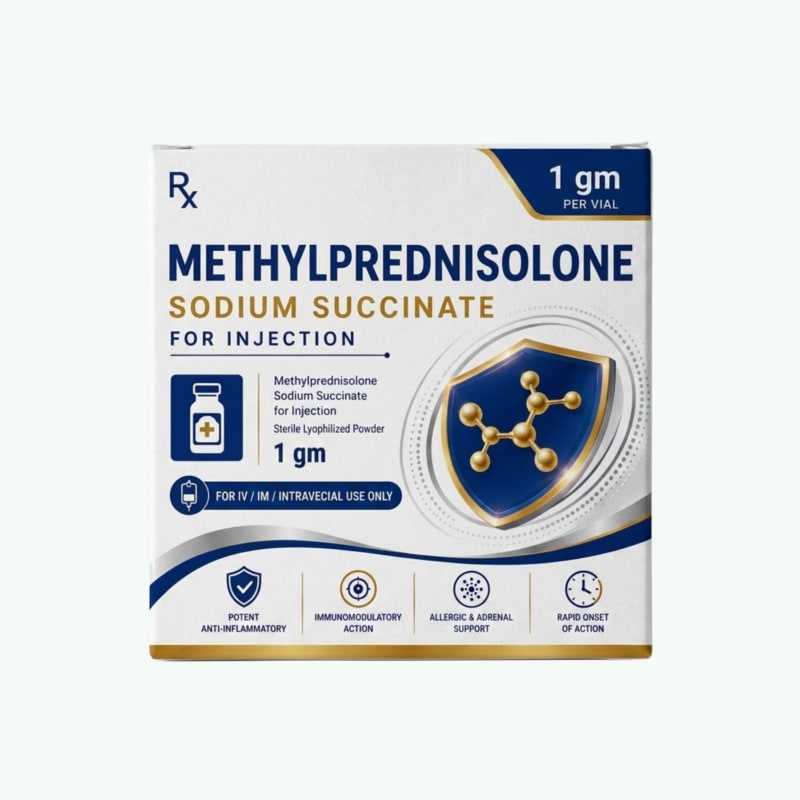
Methylprednisolone Sodium Succinate for Injection 1.0gm
There's a specific category of medicine reserved for the moments where a physician has decided that the entire treatment strategy hinges on hitting inflammation as hard and as fast as possible, and Methylprednisolone Sodium Succinate at 1 gram sits squarely in that category. This is the top-end strength, sized for a full single pulse dose without requiring a pharmacist to combine multiple smaller vials mid-shift for a patient who needs the treatment started immediately. Clinically, this dose shows up in acute transplant rejection episodes, severe lupus flares affecting major organs, aggressive multiple sclerosis relapses, and certain vasculitis protocols, where guidelines call for a full gram of methylprednisolone as a single daily dose over a short, defined course. It's not a drug that gets used casually. Every order for this strength typically corresponds to an active, serious clinical protocol running at a specific hospital right now. Because the stakes attached to this product are high, and the patients receiving it are managed in specialist units, a single-dose 1 gram vial removes the room for error that comes with drawing partial doses from a smaller-strength vial under time pressure. It's supplied as a lyophilized cake reconstituted with a larger volume of diluent given the total mass involved, and getting that reconstitution to behave consistently at this scale requires manufacturing precision that not every producer can hold across every batch. We source this strength exclusively from WHO-GMP certified manufacturers with demonstrated batch-to-batch consistency specifically at the 1 gram fill, since this isn't a product where a distributor gets a second chance to catch an inconsistency before it reaches a patient in the middle of an acute transplant rejection episode. Every shipment carries full documentation, certificate of analysis, GMP certification, and stability data, and given how tightly hospitals control access to this drug internally, procurement teams tend to review this paperwork more thoroughly than almost any other line we export. Order volumes for this strength are naturally lower and less predictable than for the smaller doses, so we keep minimum quantities correspondingly flexible, recognising that a distributor might need a handful of vials on short notice for a single active case rather than a standing monthly commitment. Fifteen years exporting critical care and speciality injectables from India has taught us that this is precisely the kind of product where a fast, direct answer to a distributor's urgent query matters more than almost anything else in the relationship. For hospital pharmacies supporting transplant medicine, rheumatology, and neurology units running high-acuity protocols, Methylprednisolone Sodium Succinate 1.0gm is the strength that ensures a full pulse dose is available the moment a specialist calls for it.

Omeprazole for Injection 40mg
Long before its cousin esomeprazole became the more fashionable choice in many hospitals, Omeprazole was the proton pump inhibitor that proved IV acid suppression could actually work, and it remains one of the most cost-effective options on a hospital formulary for exactly that reason. The 40mg vial covers the standard dose for patients who need acid suppression but can't take anything by mouth, whether due to surgery, intubation, or an acute GI event. Omeprazole works by irreversibly blocking the gastric proton pump responsible for the final step of acid secretion, and in its injectable form it's used for peptic ulcer disease, Zollinger-Ellison syndrome, stress ulcer prophylaxis in critically ill patients, and short-term management of erosive gastroesophageal reflux disease when oral therapy isn't an option. It remains a genuinely reliable workhorse in this category, valued precisely because it's been in clinical use long enough that its safety profile is thoroughly established. For distributors, Omeprazole injection tends to be a price-sensitive product line, since buyers comparing it against esomeprazole and other newer PPIs are often making a straightforward cost-effectiveness call for routine stress ulcer prophylaxis rather than a specific clinical indication that demands the newer molecule. That makes competitive, consistent pricing genuinely important here, alongside the reliability that keeps a hospital pharmacy reordering from the same source rather than shopping every tender cycle. Manufacturing this molecule requires the same lyophilization discipline as its newer relatives, since omeprazole is similarly sensitive to light and moisture degradation. We work with WHO-GMP certified partners who've refined their production process for consistent reconstitution behaviour, and every export batch ships with a complete documentation package, certificate of analysis, GMP certification, and stability data, since procurement teams treat this paperwork as seriously for a widely used generic as they do for a newer branded molecule. Because this is a high-turnover, price-competitive product, we keep minimum order quantities flexible while still offering meaningful volume-based pricing, so a distributor placing a large recurring order gets rewarded for that commitment without smaller buyers being priced out of a competitive quote. Fifteen years exporting hospital-grade injectables from India has taught us that products like this one, where the clinical decision is largely settled and the buying decision comes down to price and reliability, are exactly where a transparent, straightforward relationship with an exporter pays off the most over time. For hospital pharmacies and general medical wholesalers stocking a cost-effective acid suppression line, Omeprazole for Injection 40mg remains a dependable, frequently reordered staple.

Pantoprazole for Injection 40mg
Pantoprazole has quietly become one of the more widely stocked IV proton pump inhibitors across hospitals that need a straightforward, well-tolerated option with a favourable drug interaction profile. It's often chosen specifically because it has fewer interactions with other medications processed through the liver compared to some other PPIs, which matters a great deal in patients on complex medication regimens, particularly in cardiology and post-surgical wards where clopidogrel and other interacting drugs are common. The 40mg vial covers standard dosing for GERD, erosive esophagitis, and general acid suppression in patients unable to take oral medication, and it's also used in higher-dose regimens for acute GI bleeding protocols similar to other PPIs in this class. Reconstituted with the appropriate diluent, it's given as a slow IV injection or infusion, and its relatively stable reconstituted solution compared to some alternatives in the same drug class makes it a practical choice for busy hospital pharmacies preparing multiple doses across a shift. What distributors often mention about pantoprazole specifically is how consistently it moves, month over month, without the seasonal spikes seen in respiratory antibiotics or the burst-ordering pattern of speciality steroids. It's the kind of steady, predictable line that makes inventory planning simple for both the exporter and the importer, and that predictability is precisely what makes reliability of supply, rather than aggressive short-term pricing, the more valuable thing a supplier can offer on this particular product. Manufacturing this molecule to consistent quality requires the same lyophilization and light-protection discipline common to the entire PPI injectable class, and we source pantoprazole exclusively from WHO-GMP certified partners who've demonstrated batch-to-batch consistency over an extended track record rather than a single successful validation run. Every shipment carries full documentation, certificate of analysis, GMP certification, and stability data, keeping customs clearance and hospital pharmacy intake moving without the delays that missing paperwork causes. Given the steady, high-turnover nature of this product, we offer meaningful volume-based pricing for distributors placing recurring orders while keeping entry-level MOQs accessible for smaller regional buyers just adding this line to their catalogue. Fifteen years exporting hospital-grade injectables from India has shown that a dependable, unglamorous product like pantoprazole often becomes the backbone of a long-term distributor relationship precisely because it never causes problems. For hospital pharmacies and general medical wholesalers looking for a reliable, well-tolerated IV PPI with a favourable interaction profile, Pantoprazole for Injection 40mg is one of the steadiest lines on our pharmaceutical export catalogue.

Rabeprazole Sodium Injection 20mg
Rabeprazole works fast, chemically activating within roughly 78 seconds inside the gastric parietal cell, which is one of the quicker onset profiles among the proton pump inhibitor class. That speed matters clinically in situations like sequential-therapy step-up from oral rabeprazole, where a patient who was managing well on tablets suddenly can't take anything by mouth and needs continuity of acid suppression without a gap. The 20mg vial is the standard adult dose, used for active duodenal and gastric ulcers with bleeding or severe erosions, short-term treatment of erosive GERD, prevention of acid aspiration before procedures, and stress-induced mucosal injury in critical care settings. It's typically reconstituted with 5 to 10ml of sterile water for injection or 0.9% sodium chloride, and no other diluent should be used given the specific compatibility requirements for this formulation. What sets Rabeprazole apart in a crowded PPI injectable market is that it's genuinely intended as a bridge therapy rather than a long-term IV option, meant to be discontinued as soon as oral administration becomes possible again. That positioning makes it a common choice in post-surgical wards and short-stay units where the clinical expectation is a brief IV interval rather than an extended course, and distributors serving these settings tend to see fairly consistent, moderate-volume demand rather than large bulk orders. Manufacturing rabeprazole to the correct lyophilization specification requires the same light and moisture protection discipline common across this drug class, and we source it from WHO-GMP certified partners who maintain that consistency batch after batch. Every export shipment carries complete documentation, certificate of analysis, GMP certification, and stability data, keeping the customs and hospital pharmacy intake process moving without the delays a missing document can cause. Given that this product often serves smaller, short-stay surgical units and step-down care settings rather than large ICUs, we keep minimum order quantities accessible for regional distributors who don't need container-scale volumes to serve their customer base. Fifteen years exporting hospital-grade pharmaceutical injectables from India has shown that clear, direct communication about lead times and batch documentation matters just as much for a moderate-volume product like this one as it does for our highest-turnover lines. For hospital pharmacies and wholesalers supplying post-surgical, gastroenterology, and step-down care units, Rabeprazole Sodium Injection 20mg fills the bridge-therapy gap between oral PPI treatment and full critical care IV protocols.

Lansoprazole for Injection 30mg
Lansoprazole occupies a slightly different niche than the other PPIs on a hospital shelf. It's often the one specifically stocked for patients who can't take other oral or IV formulations well, or for institutions that have standardised their gastroenterology protocols around it based on local prescribing patterns rather than a strict clinical necessity that sets it apart from esomeprazole or pantoprazole. The 30mg strength is the standard IV dose, used for short-term acid suppression when oral therapy isn't practical, covering similar ground to the rest of the PPI injectable class: erosive esophagitis, duodenal and gastric ulcer management, and general stress ulcer prophylaxis in select hospital protocols. Like its counterparts, it works by irreversibly binding to the gastric proton pump, and the injectable form gets used specifically as a substitute when oral capsules aren't an option, whether due to post-operative status, intubation, or acute illness. For an exporter, lansoprazole tends to be a lower-volume, more regionally specific order compared to omeprazole or pantoprazole, often requested by hospitals in markets where lansoprazole has a stronger prescribing history or where a particular tender specification calls for it by name. That regional specificity is exactly why keeping this line in stock, even at modest volumes, matters for serving distributors whose local hospital contracts specifically require it rather than accepting a substitute PPI. Manufacturing this molecule to the correct lyophilization specification follows the same light and moisture protection discipline as the rest of the class, and we source it from WHO-GMP certified manufacturing partners with a demonstrated track record on PPI injectables specifically. Every shipment carries complete documentation, certificate of analysis, GMP certification, and stability data, since customs and hospital procurement across most export markets scrutinise this paperwork just as closely for a lower-volume product as for a bestseller. Given the more niche, regionally specific demand for this particular molecule, we keep minimum order quantities genuinely low for lansoprazole, recognising that a distributor may need only a modest quantity to fulfil one specific hospital contract rather than build a large standing inventory. Fifteen years exporting pharmaceutical injectables from India has shown that being willing to stock and ship smaller, specialised orders without friction is often what earns the loyalty of a distributor working in a market with particular prescribing preferences. For hospital pharmacies and wholesalers serving markets where lansoprazole is the preferred or tender-specified PPI, this 30mg injectable vial ensures that specific requirement gets met without forcing a substitution the buyer didn't ask for.

Thiopental Sodium for Injection 500mg
Before propofol became the default choice for induction anaesthesia, Thiopental Sodium was the drug that did the job for decades, and it hasn't actually disappeared from operating theatres and ICUs the way some assume. This ultra-short-acting barbiturate still gets reached for specifically in situations where its particular pharmacological profile, rapid onset paired with a relatively predictable, controllable depth of sedation, works better than the alternatives. The 500mg vial is a standard strength for induction of general anaesthesia before surgical or diagnostic procedures, and it also has a role in managing status epilepticus when other anticonvulsants haven't controlled seizure activity, in reducing intracranial pressure in select neurocritical care situations, and historically in veterinary euthanasia protocols where regulations permit. It's supplied as a lyophilized powder that must be reconstituted with sterile water immediately before use, since the reconstituted solution doesn't hold up well over time and any unused portion needs to be discarded rather than saved. This is a controlled, prescription-only anaesthetic agent, and regulatory scrutiny around barbiturates in general runs higher than for most other product categories on a pharmaceutical export catalogue. Buyers ordering this product are almost always licensed hospitals, surgical centres, or veterinary institutions operating under the appropriate controlled-substance authorisations in their own jurisdiction, and documentation on our end reflects that reality with a complete regulatory file, certificate of analysis, GMP certification, and the specific export licensing paperwork this category requires. Manufacturing thiopental sodium to a consistent standard requires stable production under controlled conditions given the compound's sensitivity, and we source exclusively from manufacturers holding the appropriate certifications for controlled pharmaceutical substances, with cold-chain and secure handling maintained from production through export packing. A shipment that doesn't reconstitute cleanly on the day of a scheduled surgical procedure is not a problem any operating theatre can absorb gracefully. Given the controlled nature of this product and the licensing requirements that vary meaningfully by importing country, we work closely and directly with each buyer on the specific documentation their local regulatory authority requires before a shipment moves, rather than assuming a one-size-fits-all export process applies. Fifteen years exporting pharmaceutical products from India, including controlled substances requiring this level of regulatory coordination, has shown us that patience and precision on paperwork here matters just as much as the product quality itself. For licensed hospitals, surgical centres, and veterinary institutions requiring a reliable source of Thiopental Sodium under proper controlled-substance authorisation, this 500mg vial remains a genuinely useful, still-relevant anaesthetic option.